Time signatures and rhythm, from zero
Most people who play an instrument badly play it badly in time, not in tune. A wrong note is a moment; a wrong rhythm derails everything after it. And unlike pitch, rhythm has no tuner to tell you that you are off – which is why it is worth understanding properly rather than absorbing by osmosis.

What the two numbers actually say
A time signature looks like a fraction and is not one. It is two separate pieces of information stacked on top of each other.
The bottom number names the note value that gets one beat: 4 means a quarter note, 8 means an eighth note, 2 means a half note. The top number says how many of those fit in a bar.
- 4/4 – four quarter notes per bar. So standard that it is written C for "common time", and so dominant that the overwhelming majority of pop, rock and blues never leaves it.
- 3/4 – three quarter notes. Waltz. One-two-three, one-two-three, with the weight on the first.
- 2/4 – two quarter notes. Marches and polkas; a brisk, clipped feel.
- 6/8 – six eighth notes, but that is not how it is counted. See below.
- 5/4 and 7/8 – odd meters. "Take Five" and much of Balkan folk music live here.
Note values divide, they do not add up
The system is binary the whole way down, and once you see that, reading rhythm gets much easier.
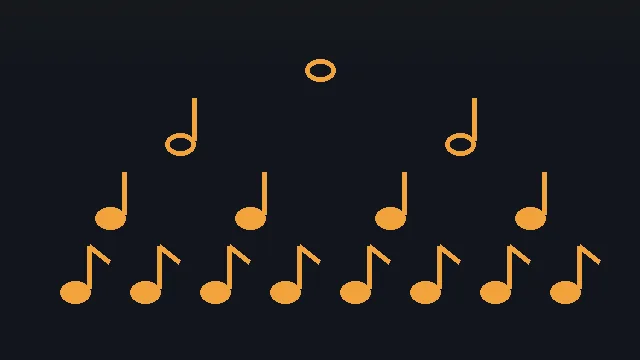
A whole note is the reference. A half note is half of it, a quarter note half of that, then eighths, then sixteenths. In 4/4 that means one whole note, or two halves, or four quarters, or eight eighths, or sixteen sixteenths – each layer fills exactly the same bar.
A dot after a note adds half of its own value: a dotted quarter is a quarter plus an eighth, that is three eighths. That single rule accounts for most of the rhythms that look intimidating on the page.
A triplet is the exception to the binary system. It squeezes three notes into the space of two, and the shuffle feel behind almost every blues is a triplet with its middle note left out.
6/8 is not 3/4, and this is the useful part
Six eighth notes per bar. Three quarter notes per bar. Six eighths and three quarters occupy the same total length, so on paper the bars are the same size. Musically they are nothing alike.
3/4 is counted in three: ONE two three, ONE two three. Three beats, each divided in two.
6/8 is counted in two: ONE two three FOUR five six. Two beats, each divided in three.
The time signature is telling you where the pulse is and how the pulse divides, not just how many symbols fit in a bar. That is the difference between a waltz and the rolling, galloping feel of "House of the Rising Sun" or most Irish jigs. Meters that divide the beat into three are called compound meters, and 6/8, 9/8 and 12/8 are all of them.
Subdivision is the actual skill
Here is the thing that separates players with good time from players who rush: they are not counting beats, they are counting the spaces between beats.
If you can only feel the four quarter notes in a bar, everything in between is guesswork, and guesswork is where rushing comes from. If you are internally counting "one-and-two-and-three-and-four-and", every eighth note has a slot to land in. Count sixteenths – "one-e-and-a" – and the resolution doubles again.
Practise this deliberately. Set the metronome to a slow tempo, play nothing at all, and count subdivisions out loud with the click. It feels remedial. It is the exercise that fixes more timing problems than any other.
How to practise with a metronome without hating it
The complaint about metronomes is always the same: they are rigid, boring, and playing to one feels like nothing musical is happening. Usually that means the metronome is being used badly. Four things change the experience.
Slow down further than feels reasonable. If a passage falls apart at 90 bpm, practising it at 90 rehearses the falling apart. Drop to 60. Play it cleanly ten times. Then go up by four.
Move the click off beat one. Set it to half speed and hear it as beats 2 and 4 instead of every beat. Suddenly you are keeping time and the metronome is confirming it, rather than the other way round. This one change does more for feel than any other.
Take the click away. Set it to sound only on the first beat of every bar, then every second bar. The silence is where you find out whether your time is actually yours. Fill it correctly and you have internalised the tempo; drift and you know precisely how much.
Notice which direction you drift. Rushing and dragging are different problems. Rushing usually comes from tension – the right hand tightening on hard passages. Dragging usually comes from thinking, the beat waiting while you work out the next chord. The fix differs, so the diagnosis matters.
Where tempo markings come from
Tempo is in beats per minute, and the traditional Italian terms are ranges rather than points: largo is roughly 40–60, andante a walking 76–108, allegro a bright 120–168, presto 168 and up.
They are worth knowing, but bpm is worth knowing better, because it is measurable. When you find a comfortable tempo for a piece, write the number down. Next week you will know whether you have actually got faster or whether it just felt that way.
Putting it together
Rhythm is trainable in a way that feels much less mysterious than it looks from the outside, and it responds to short, frequent work better than long sessions.
Five minutes a day with the metronome, counting subdivisions out loud, will do more for your playing than an hour of running through songs. Once the pulse is steady, tuning matters again – a well-timed chord on an out-of-tune guitar still sounds wrong – and the two halves of playing in time and playing in tune start reinforcing each other. If you want the pitch side of the same coin, intervals is where to go next.