Intervals: the building blocks of all music
An interval is the distance between two notes. Every melody is a sequence of them and every chord is a stack of them, so learning to hear a dozen intervals is the single highest-leverage thing a self-taught musician can do. But the word "distance" hides something that trips almost everyone up at the start, and getting it straight early saves a lot of confusion later.
Distance is counted in steps but heard as a ratio
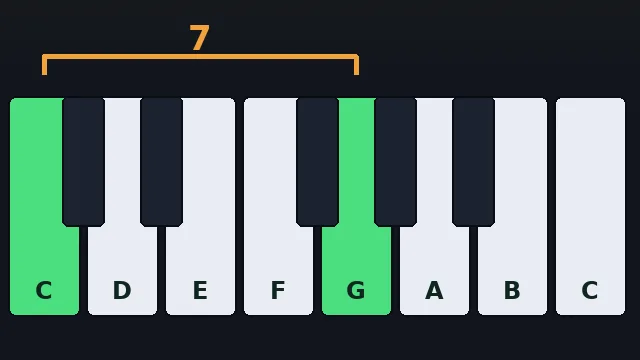
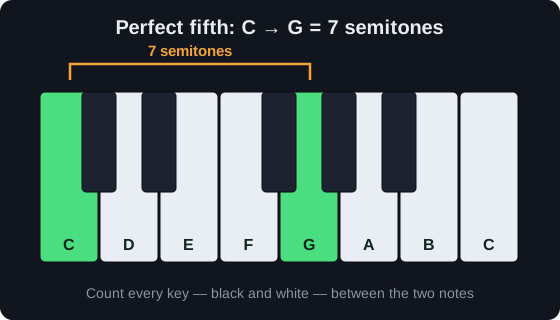
On your instrument an interval looks like a count. A semitone is one fret, one key including the black ones, one step. A perfect fifth is seven of those steps, always, everywhere on the neck. That is the arithmetic you use to find notes.
Your ear is doing something else entirely. It is comparing frequencies, and it compares them by dividing, not by subtracting. The A above middle C is 440 Hz. The A an octave up is 880 Hz – double it. Another octave up is 1760 Hz. Each octave adds the same musical distance and doubles the number. Go down instead and you halve: 220, 110, 55.
That is why the frets on a guitar get closer together as you go up the neck. Each one multiplies the frequency by the same small factor, and a multiplication of a bigger number covers more hertz in less space. The fretboard is a logarithmic ruler, and the twelfth fret – the octave, double the frequency – sits at exactly half the string length.
Why some intervals sound stable
Pluck a string and you do not get one frequency. You get a fundamental plus a series of quieter overtones at two, three, four, five times that frequency. This is the harmonic series, and it is present in every note any string or pipe produces.
Now play two notes together. If their overtone series line up, the ear hears a single reinforced sound. If they do not, the overtones sit close to each other and beat, and the ear hears friction.
The simpler the frequency ratio, the more overtones coincide:
- Octave, 2:1 – every overtone of the upper note is already in the lower one. Maximum blend; so complete that we give both notes the same letter name.
- Perfect fifth, 3:2 – the next simplest, and the next most stable. This is why a power chord sounds solid without being either major or minor, and why the whole tuning system of the Western world was built by stacking fifths.
- Perfect fourth, 4:3 – stable, but with a slight lean; it wants to resolve.
- Major third, 5:4 – sweet, and the note that decides major from minor.
- Minor second, 16:15 – a ratio that shares almost nothing. The overtones grind against each other, and that grinding is exactly what a horror-film composer is after.
The tritone, the interval that splits the octave in half, has no simple ratio at all. Medieval theorists called it diabolus in musica, and it still sounds unresolved to modern ears for a completely physical reason.
The interval table, with something to hang it on
Mnemonics work. Attach one song to each interval and you can name them in real music within a few weeks.
- Minor 2nd (1 semitone, ~16:15) – the Jaws theme. One fret.
- Major 2nd (2, 9:8) – the first two notes of "Happy Birthday".
- Minor 3rd (3, 6:5) – the sad third; it turns a chord minor.
- Major 3rd (4, 5:4) – the bright third; it makes a chord major.
- Perfect 4th (5, 4:3) – "Here Comes the Bride"; also the gap between most adjacent guitar strings in standard tuning.
- Tritone (6) – maximum tension; the opening of The Simpsons theme.
- Perfect 5th (7, 3:2) – the power-chord interval; the Star Wars main title.
- Minor 6th (8, 8:5) / Major 6th (9, 5:3) – leaping and romantic; "My Bonnie" for the major sixth.
- Minor 7th (10) / Major 7th (11) – the colour in dominant 7th and maj7 chords.
- Octave (12, 2:1) – "Somewhere Over the Rainbow".
The catch: your guitar does not actually play those ratios
Here is the part most interval lessons leave out. A modern instrument is tuned in equal temperament: the octave is divided into twelve identical steps, each one the twelfth root of two. That makes every key equally usable and every chord shape movable, which is the whole reason the system won.
It also means only the octave is exactly in tune. The equal-tempered fifth is about two cents narrower than a true 3:2 – inaudible. The equal-tempered major third is about fourteen cents sharp of a true 5:4, which is not inaudible at all. If you have ever tuned a guitar perfectly with a meter and still found an open E chord slightly sour, that fourteen cents is why. There is a longer version of this argument in why a guitar goes out of tune, and the historical consequences are the subject of the circle of fifths.
So the numbers above are what your ear is reaching for, and the frets are a very good approximation of them. Both facts matter.
Why this pays off on the fretboard
Guitar strings in standard tuning are a perfect fourth apart – except G to B, which is a major third. That one irregularity is the reason chord shapes look the way they do, and the reason the same shape has to be fingered differently when it crosses the B string.
Once you see the fretboard as intervals rather than positions, several things collapse into one idea. A power chord is a root, a fifth and an octave. The only difference between C major and C minor is one semitone in the third. Transposing a riff is adding the same number to every fret. And a shape you know on guitar can be rebuilt on a ukulele by asking which intervals it contains rather than trying to remember a new picture. How chords are built takes that idea all the way through to seventh chords.
Train the ear, not just the fingers
Reading about intervals is like reading about swimming. The skill is auditory and it only comes from repetition.
Ten minutes a day in the free ear training drills is enough. Start at level 1, which uses only fourths, fifths and octaves – the three most distinct intervals, and the three easiest to lock in. Add thirds when those are automatic, then sixths and sevenths. Within a few weeks you will start naming intervals in songs on the radio without meaning to.
Tuning helps too, and you are already doing it. When you tune a string against a reference tone, you are matching a unison – the simplest interval there is – and listening for the beats to slow down and stop. That is the same skill, applied to a ratio of 1:1.