How chords are built (one recipe, endless music)
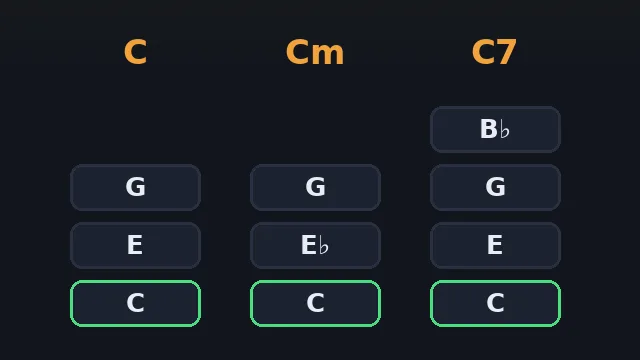
Every chord in popular music comes from one recipe: take a scale, pick a note, and stack notes a third above it. Do it twice and you have a triad. Do it three times and you have a seventh chord. That is genuinely the whole system, and it is worth an afternoon to learn because it turns chord charts from symbols to be memorised into instructions to be read.
But there is a second half that chord lessons usually skip, and it is the half that explains why the diagram in front of you has only four notes when the formula says five. This article covers both.

The recipe
Number the notes of the major scale from 1 to 7. In C that is C D E F G A B. A chord is a selection from those numbers, and the selection has a name.
- Major (1 3 5) – C E G. Bright, settled, the default.
- Minor (1 ♭3 5) – C E♭ G. Lower the third by one semitone; everything else is identical. That single semitone is the entire difference between C major and C minor.
- Diminished (1 ♭3 ♭5) – flatten the fifth too, and the chord loses its footing entirely.
- Augmented (1 3 ♯5) – raise it instead, and the chord hangs, unresolved, in any direction.
- Suspended (1 4 5 or 1 2 5) – replace the third with the note above or below it. No third means no major and no minor: sus chords are neutral, and they are the reason DADGAD and other modal tunings sound the way they do.
Add another third on top of a triad and you get the four-note chords:
- Dominant 7 (1 3 5 ♭7) – the restless one. It is built on the fifth degree of a key and it pulls hard back to the root. Nearly all blues is made of these.
- Major 7 (1 3 5 7) – the same chord with the seventh raised. Soft, floating, unmistakably the sound of a bossa nova or a ballad.
- Minor 7 (1 ♭3 5 ♭7) – the workhorse of soul and jazz rhythm playing.
Note what the formulas do not contain: any mention of the instrument. A C major chord is C, E and G whether you are holding a guitar, a ukulele or nothing at all. The instrument only decides where those three notes are available and which of them you can physically reach.
Why the chord you play has fewer notes than the chord you named
Look up C7 in almost any chord dictionary and you will find x32310. Written out, that is C, E, B♭, C, E – root, third, flat seventh. The G is missing, and the formula said 1 3 5 ♭7.
This is not an error, and it is not laziness. There is a hierarchy of importance inside a chord, and it comes straight from what each note is doing:
- The third and the seventh are essential. They are what make the chord that chord. Drop the third and you no longer have major or minor. Drop the seventh and the chord is a plain triad again. Jazz pianists comping under a soloist often play nothing else – the two notes carry the harmony on their own.
- The fifth is the first to go. In a plain major or minor triad it matters, because there is little else there. But add a seventh and the fifth is doing almost nothing: it duplicates the strongest overtone of the root, so the root is already implying it. Our own chord generator will omit a perfect fifth from any chord of four notes or more for exactly this reason.
- An altered fifth never goes. A ♯5 or ♭5 is not colour, it is the identity of the chord. Omit the ♭5 from a 7♭5 and you have simply played a dominant 7th.
- The root can go too. In a band the bass player is on it. On guitar this is more common than beginners expect: a great many usable jazz voicings have no root at all.
Once you know the hierarchy, a chord chart stops being a set of pictures. You can look at an unfamiliar shape, work out which notes it actually contains, and decide whether it is the voicing you want.
Six strings, four fingers, twelve notes
A guitar has six strings and you have four fingers. That constraint, not theory, is what shapes the chord vocabulary of the instrument.
Three things follow from it. First, doubling: a six-string chord usually contains three or four distinct notes spread over five or six strings, so several are repeated in different octaves. That doubling is a large part of why a strummed guitar chord sounds fuller than the same three notes on a piano.
Second, inversions. Which note ends up lowest changes the character of a chord without changing its name. The same C major with E in the bass sounds lighter and more transitional – useful for a descending bass line under a static chord.
Third, muted strings. The x in x32010 is not decoration. It means that string must not sound, because the note on it is wrong for the chord. Damping unwanted strings with the side of a finger is a technique worth as much practice as the fretting itself.
The same chord on a different instrument
A ukulele has four strings and standard tuning puts them all inside a single octave, with the fourth string tuned above the third. That re-entrant string is why ukulele chords sound like a cluster rather than a spread, and why a shape borrowed from the guitar does not transfer as a picture.
It transfers as intervals. Ask which notes a chord needs, find them on whatever instrument is in your hands, and the shape follows. A mandolin tuned in fifths needs different fingerings again, and a bass usually plays the root alone. The recipe never changes; only the layout does.
What to do with this
Three exercises, in order.
Take a chord you already play and name its notes out loud, string by string, from a chord diagram. Do that for ten chords and the fretboard starts to have note names on it instead of dots.
Then go the other way. Pick a chord symbol you do not know – Am7, F♯m, Gsus4 – work out its notes from the formulas above, and find them yourself before you look up the shape.
Finally, listen. The difference between a major and a minor third is one fret and an entire emotional register, and hearing it reliably is a trainable skill. The ear training drills cover chord qualities as well as intervals, and intervals is the companion piece to this one – chords are stacked intervals, so the two subjects are really one subject approached from opposite ends.