The circle of fifths, finally explained
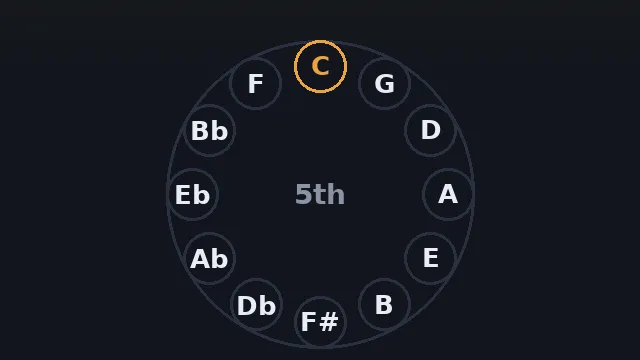
The circle of fifths gets drawn on whiteboards, printed on posters and tattooed on forearms, and most explanations stop at "it shows you the key signatures". It does, but that is the least interesting thing about it. It is really a map of how close keys are to each other, and once you can read it you can transpose on sight, work out the chords of any key in seconds and guess where a song is going before it gets there.
Why fifths, and why it closes
Start on C and go up a perfect fifth: G. Up another fifth: D. Keep going – A, E, B, F#, C#, G#, D#, A#, F – and after twelve steps you arrive back at C.
That is worth pausing on, because it is not obvious that it should work. A pure fifth is a frequency ratio of 3:2. Stack twelve of those and you overshoot seven octaves by about 23 cents, a gap known as the Pythagorean comma. The circle only closes because equal temperament shaves every fifth by two cents, which nobody hears, and the error is spread out until the ends meet.
So the neat diagram on the poster is a consequence of the same compromise that makes your guitar's major thirds sound slightly restless. The circle is not a law of nature. It is a very good approximation that the western world agreed to.
Reading it
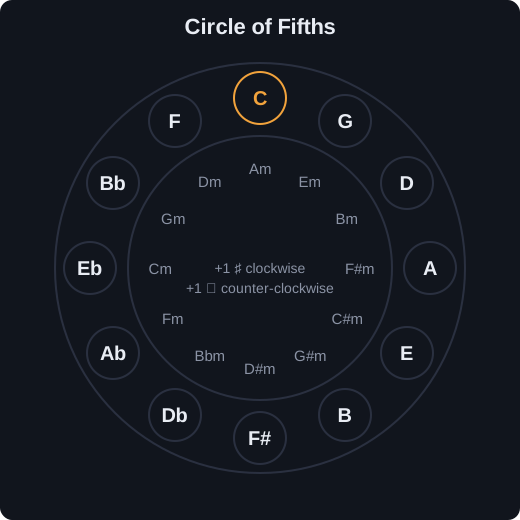
Clockwise from C, each step adds one sharp: G has one, D has two, A three, E four, B five. Counterclockwise, each step adds one flat: F has one, B flat two, E flat three, A flat four.
The sharps always arrive in the same order – F, C, G, D, A, E, B – and the flats in exactly the reverse – B, E, A, D, G, C, F. That is not a coincidence. Each new key is a fifth away, and a fifth away is precisely the distance that adds one accidental.
Two shortcuts worth memorising:
- For sharp keys, the last sharp is one semitone below the key name. Three sharps ending on G sharp means the key is A.
- For flat keys, the second-to-last flat is the key name. Flats ending B, E, A means the key is E flat.
Inside the circle sit the relative minors: A minor inside C, E minor inside G, B minor inside D. A key and its relative minor share a key signature and every note. They differ only in which note feels like home.
The chords of a key, at a glance
Here is the part that earns the circle its place on your wall. Take any major key and look at its position, the position to its left, and the position to its right. Those three are the major chords of the key. The three relative minors sitting inside them are the minor chords.
For C major: F, C, G are the majors; D minor, A minor, E minor are the minors. That is six of the seven chords in the key. The seventh is the diminished chord built on the leading tone – B diminished in C – and it turns up far less often.
In Roman numerals the pattern is I, ii, iii, IV, V, vi, vii°. It holds for every major key, which is why one diagram replaces twelve separate lists.
Why neighbouring keys sound related
Keys next to each other on the circle share six of their seven notes. C and G differ by exactly one: F versus F sharp. That single note is the whole reason a change from C to G sounds smooth and a change from C to F sharp sounds like a jolt.
This is the practical definition of key distance, and composers use it constantly. Move one step clockwise and the music brightens. One step counterclockwise and it settles. Jump across the circle and you get the sound of a key change that announces itself.
The progression that walks the circle
Play C, then F, then B diminished, then E minor, A minor, D minor, G, and back to C. Every step is a fifth down. This is called a circle progression, and once you notice it you will hear it everywhere, from baroque sequences to jazz standards to pop bridges.
The most common fragment of it is ii–V–I: D minor, G, C. Two steps around the circle, landing home. It is the single most common cadence in western music, and it is just a short walk on this map.
Transposing without pain
Someone asks you to play the song a fourth higher. Do not recalculate every chord. Rotate.
Find the original key on the circle, find the new key, and move every chord by the same number of positions in the same direction. A progression that was C–Am–F–G in C becomes G–Em–C–D in G. The shape of the move is identical; only the starting point changed.
This is also how a capo works. Clamping at the second fret shifts everything up two semitones, which is two positions clockwise on the circle. Guitarists who know this can play in E flat using open D shapes and a capo at the first fret without thinking about it.
Why guitar music lives where it does
Look at where open chords fall: E, A, D, G, C. Those are five adjacent positions on the circle, and that is not an accident – the guitar's standard tuning is itself built mostly from fourths, which is the circle read backwards.
That is why so much guitar repertoire sits in those keys, and why songs in E flat or A flat feel awkward under the fingers. It also explains what alternate tunings do: Open G or DADGAD relocate the easy keys somewhere else on the circle, which is exactly why players reach for them.
How to actually learn it
Do not memorise the picture. Build it.
- Say the sharp order out loud until it is automatic: F C G D A E B. The flat order is the same list backwards.
- Each day, pick one key and name its six chords from the circle without looking.
- Play the ii–V–I in three different keys. Your hands will learn the distance before your head does.
- Train your ear on the interval itself. A perfect fifth is the most recognisable interval after the octave; the ear training drills start there.
Then use it on real music. Work out the key of a song you know, list the chords the circle predicts, and check how many the song actually uses. Most pop songs use four of them. Knowing which four, and why those four, is most of what music theory is for.
Start with the two keys that hold most of the guitar repertoire: G major and its relative minor, E minor.