Why your guitar goes out of tune – the physics and the fixes
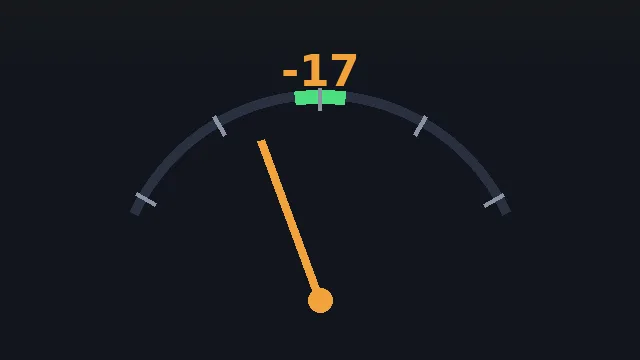
Here is the thing nobody tells beginners: your guitar is never perfectly in tune, and it never can be. Not because it is cheap, not because you are doing it wrong. A fretted instrument is a compromise built into the design, and understanding which part of the problem is physics and which part is fixable will save you a lot of frustration at the tuning pegs.
The compromise every fretted instrument carries
Play two notes whose frequencies form a simple ratio and they sound sweet. A perfect fifth is a 3:2 ratio, a major third is 5:4. Stack pure intervals like that and you get a tuning that sounds glorious in one key and unusable in another, because the pure intervals do not close back into a neat octave.
The fix the western world settled on is equal temperament: split the octave into twelve exactly equal steps and accept that every interval except the octave is slightly wrong. The fifth ends up two cents narrow, which nobody hears. The major third ends up fourteen cents sharp, which plenty of people hear.
Fourteen cents is not a rounding error. It is roughly three times the tolerance your tuner treats as in tune. It is the reason a big open E major chord can sound faintly restless even when every string reads a perfect zero.
Your frets are placed for equal temperament. Nothing you do at the tuning pegs changes that.
Why the B string is always the troublemaker
Ask guitarists which string misbehaves and most say the B. They are right, and the reason is the interval structure of standard tuning.
Five of the six string pairs are a perfect fourth apart. One pair – G to B – is a major third. That is precisely the interval that equal temperament treats worst. So the G-to-B relationship carries the compromise that the other five do not, and it shows up in exactly the chords that use those two strings in the open position.
This is also why so many players quietly tune the B string a few cents flat by ear and then wonder why the tuner disagrees. The tuner is right about equal temperament. The ear is right about the chord being played. Both can be true.
Pressing a string down makes it sharper
Here is the second structural problem, and it is pure geometry.
To fret a note you push the string down onto a fret. That stretches it slightly, which raises the tension, which raises the pitch. The amount depends on how high the strings sit above the fretboard, how thick the string is, and how hard you press.
The consequences are immediate:
- A guitar with high action plays sharper than one with low action, everywhere.
- Heavy-handed players fret sharper than light-handed players on the same instrument.
- The effect is largest near the nut, where the string is stretched proportionally more.
Nobody tunes this away. It is corrected at setup, by moving the bridge saddles so the string length compensates for the stretch. That adjustment is called intonation, and it is a different job from tuning – see the last section.
Strings are not ideal strings
Textbook physics assumes a string is infinitely flexible. Real strings have stiffness, especially the thick wound ones, and a stiff string's overtones are not exact multiples of its fundamental. They run progressively sharp.
This is inharmonicity, and it has two practical consequences.
First, tuning by harmonics does not give the same answer as tuning by open strings, because the harmonics themselves are slightly sharp of where theory puts them. The old twelfth-fret harmonic method is close, but it drifts.
Second, a pitch detector has to decide what the fundamental is from a signal whose partials do not line up neatly. Good detectors handle this. It is also why a dead, corroded string reads erratically: corrosion and uneven wear make the inharmonicity worse and irregular, and the string becomes what luthiers call false. No amount of tuning rescues a false string.
What actually changes while you play
Everything above is constant. These are the parts that move during a session:
- Temperature. A guitar brought in from the cold has a cold neck, cold strings and cold hardware, all contracting and expanding at different rates. Give it twenty minutes before tuning is worth the effort. Stage lights do the same thing in reverse.
- Humidity. Wood takes on and gives up moisture, and the neck relief changes with it. Seasonal swings are the reason a guitar that held tune all summer suddenly will not in winter.
- New strings stretching. The first day or two of a set's life is continuous creep. Pre-stretch them instead of waiting.
- Your right hand. Dig in hard and the pitch rises for the moment of the attack. On a light-gauge set with high action, that alone can be several cents.
- Bends and vibrato. Every bend drags a little string through the nut slot. If the slot is tight, the string does not slide all the way back.
The hardware that genuinely fails
When a guitar will not hold tune for more than a few minutes, it is nearly always one of these four:
- The nut binds. The single most common cause. You turn the peg, the pitch does not rise smoothly but jumps with a small ping, and the string goes flat as soon as you play. The slot is too narrow, too rough or too dry. Pencil graphite in the slot is the standard first aid; a proper slot file is the real fix.
- The string is wound badly. Too few turns on the post and it slips under tension. Too many and the turns cross over each other, then settle one by one. Two or three neat turns, wound downward toward the headstock face, is what you want.
- The tuners have play. Cheap machine heads have loose gears and worn bushings. If the button moves before the string does, the tuner is the problem.
- The strings are old. Corroded and pitted strings go false, as above. If a guitar has started misbehaving after months on the same set, change them before diagnosing anything else.
Note what is not on this list: the truss rod. It affects relief and playability, not tuning stability.
What professionals actually do
They retune between songs. Often mid-song, in the gaps.
That is worth internalising, because beginners assume a well-set-up guitar stays put. It does not, and the people who play for a living know it. A tuner on the pedalboard is not a sign of weak ears; it is an acknowledgement that a wooden instrument under fifty kilograms of string tension is always moving.
Some go further. Compensated nuts shift each string's effective length individually. Sweetened tunings offset specific strings by a few cents to favour the keys a given song lives in. These are real solutions to the equal-temperament problem, not gimmicks – but they optimise for some chords at the cost of others. There is no setting that makes everything perfect, only settings that move the error where you will not notice it.
Tuning versus intonation: the distinction that saves hours
If the open strings read perfectly and chords still sour as you move up the neck, the guitar is in tune and out of intonation. Tuning is about the open strings. Intonation is about whether fretted notes stay correct along the fretboard, and it is set at the bridge saddles.
The test takes a minute. Play the natural harmonic at the twelfth fret, then the fretted note at the twelfth fret. They should read the same. If the fretted note is sharp, the string's speaking length needs to grow – move the saddle away from the neck. If it is flat, shorten it. Repeat per string.
If you are retuning constantly and the open strings were fine all along, you have been trying to solve a setup problem with a tuning peg.
What is actually worth doing
- Pre-stretch new strings rather than waiting them out.
- Always come up to the note, never down to it.
- Graphite in the nut slots if the pitch jumps when you tune.
- Two or three neat winds per post.
- Change strings when they dull; a false string cannot be tuned.
- Let a cold instrument acclimatise before you bother.
- Check intonation at the twelfth fret before blaming the tuning.
- Retune between pieces, like everyone who does this for a living.
And accept the last fourteen cents. The tuner will get you to equal temperament, which is as in tune as a fretted guitar gets. If you want to hear how differently the same chord sits in other tunings, the full tuning reference has every one of them, and the chord library shows the shapes.