How to tune a guitar (without fighting it)
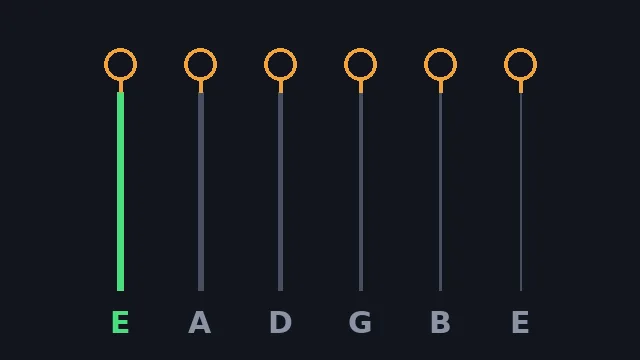
Standard tuning on a six-string guitar is E2 A2 D3 G3 B3 E4 – read from the thickest string to the thinnest. The letters are the notes; the numbers are the octaves, which matter more than beginners expect. Both outer strings are an E, but the thin one sounds two octaves higher than the thick one. If a tuner tells you the low string is already an E and it still sounds wrong, you are almost certainly an octave off.
Guitarists count strings from the thin one: the high E is the 1st string, the low E is the 6th. Fretboard diagrams, on the other hand, are usually drawn with the thick string on the left. That mismatch causes more confusion than any other part of learning to tune, so it is worth fixing in your head now.
If you want the sentence trick: Eddie Ate Dynamite, Good Bye Eddie runs from the 6th string to the 1st.
Always arrive at the note from below
This is the single habit that separates players whose guitars stay in tune from players who retune every ten minutes.
A tuning machine is a worm gear, and every gear has a little slack in it. When you tune downward, you leave the string resting against that slack, and the first hard strum takes it up. When you tune upward, the gear is already loaded and the string is pulling against a tight mechanism.
There is a second reason. A string does not slide smoothly through the nut slot – it binds slightly, then releases. Tuning down leaves the tension uneven along the string: higher behind the nut, lower over the fretboard. Play a few chords and it equalises, which you hear as the string going flat.
So: if a string is sharp, do not nudge it down to the target. Take it clearly below the target – a semitone is plenty – then come back up slowly. Every time.
The fastest reliable workflow
- Open the guitar tuner and allow microphone access.
- Sit somewhere reasonably quiet. The detector is looking for one pitch; a television in the room gives it several.
- Play the 6th string (low E) near the soundhole or the pickup, one clean note. Do not strum all six.
- Watch the needle. Below zero means flat, so tighten. Above zero means sharp, so loosen well past the target and come back up.
- When the reading sits inside plus or minus five cents, move on.
- After all six strings, go back and check the 6th again.
That last step is not superstition. Bringing six strings up to pitch adds roughly forty to fifty kilograms of pull on the neck, and the neck flexes under it. The string you tuned first was tuned against a different amount of tension than the one you tuned last.
On a badly out-of-tune guitar, expect to go around twice. On a guitar that was only slightly off, one pass plus the check is enough.
What the cents reading actually means
A cent is one hundredth of a semitone. Twelve hundred cents make an octave.
Trained ears start noticing a difference around five cents on a sustained note, and around two to three cents when two strings are ringing together. Inside plus or minus five cents, a chord sounds clean. That is why the tuner turns green there rather than demanding a perfect zero.
Chasing an exact zero is wasted effort anyway. The reading moves while the note decays, because the string is slightly sharp in the first instant after the pluck and settles as it quietens. Pluck with moderate force, let the attack pass, and read the needle a second later.
Why new strings refuse to stay in tune
Fresh strings keep stretching for a day or two, and the winding also beds down against the post. Nothing is wrong with your guitar.
You can compress that into five minutes:
- Tune the string up to pitch.
- Hold it down at the 12th fret and gently pull it away from the fretboard, about a centimetre, along its whole length.
- Retune. It will have dropped noticeably.
- Repeat two or three times per string, until the drop becomes small.
Do this with your hand, not with force. You are seating the winding, not testing the breaking point.
Tuning by ear, and when it beats a tuner
A microphone tuner needs to hear the string. In a loud room, at a rehearsal or on a noisy street, it will struggle. Tuning by ear does not care.
The classic method: fret the 6th string at the 5th fret and match the open 5th string to it. Same at the 5th fret of the 5th string for the open 4th, and the 4th for the open 3rd. Then the exception – fret the 3rd string at the 4th fret to match the open 2nd, because the interval between those two strings is a major third rather than a fourth. Then back to the 5th fret for the 1st string.
What you listen for is the beating: a slow wah-wah-wah where two nearly-identical pitches interfere. As the strings converge the beating slows, and at the moment they match it disappears. Beating is far easier to hear than pitch itself, which is why this works even for people who say they have no ear.
The catch is that errors accumulate down the chain. Use it to get playable, then check against a reference. Every string card in the tuner plays its own reference tone, so you can tune one string to the reference and the rest by ear.
When it will not stay in tune no matter what
If the guitar drifts within minutes and none of the above helps, the cause is usually mechanical:
- The nut is binding. You tune up, the pitch jumps rather than rising smoothly, and there is a small ping. The slot is too tight or too dry. A little graphite from a pencil in the slot is the standard first aid.
- The strings are old. Corroded, worn strings go false – they no longer produce a clean harmonic series, so the tuner hunts and chords sound sour even at a perfect reading.
- The string is not wound properly. Too few turns on the post and it slips; too many and they cross over each other and slowly collapse. Two or three neat turns is the target.
- Temperature and humidity changed. A guitar carried in from the cold needs twenty minutes to settle before tuning is worth doing.
Tuning and intonation are different problems
Here is a distinction that saves a lot of pointless retuning. If the open strings read perfectly but chords go sour as you move up the neck, the guitar is in tune and out of intonation. Tuning is about the open strings; intonation is about whether fretted notes stay correct up the fretboard, and it is adjusted at the bridge saddles, not the tuning pegs.
Quick test: play the harmonic at the 12th fret, then the fretted note at the same fret. They should read the same. If the fretted note is sharp, the string length needs to grow; if flat, it needs to shrink. That is a setup job, not a tuning job.
Beyond standard tuning
Once standard feels automatic, the rest of the instrument opens up. Drop D needs one string moved and makes power chords a single finger. Half step down eases string tension and suits a lot of singing ranges. Open tunings like Open G and DADGAD turn the open strings into a chord and are the foundation of slide and Celtic playing.
The full tuning reference lists every tuning for every instrument, with its notes and alternate names, if you want to see what is out there.
The short version
- Standard is E2 A2 D3 G3 B3 E4, thick to thin.
- Always come up to the note, never down to it.
- Plus or minus five cents is in tune. Zero is not required.
- Check the 6th string again after the other five.
- Stretch new strings instead of waiting for them.
- Learn the beating method for loud rooms.
- If it still drifts, look at the nut, the strings and the winding – not the tuner.
When you are ready to use it, here are the chord shapes for guitar in whatever tuning you landed on.